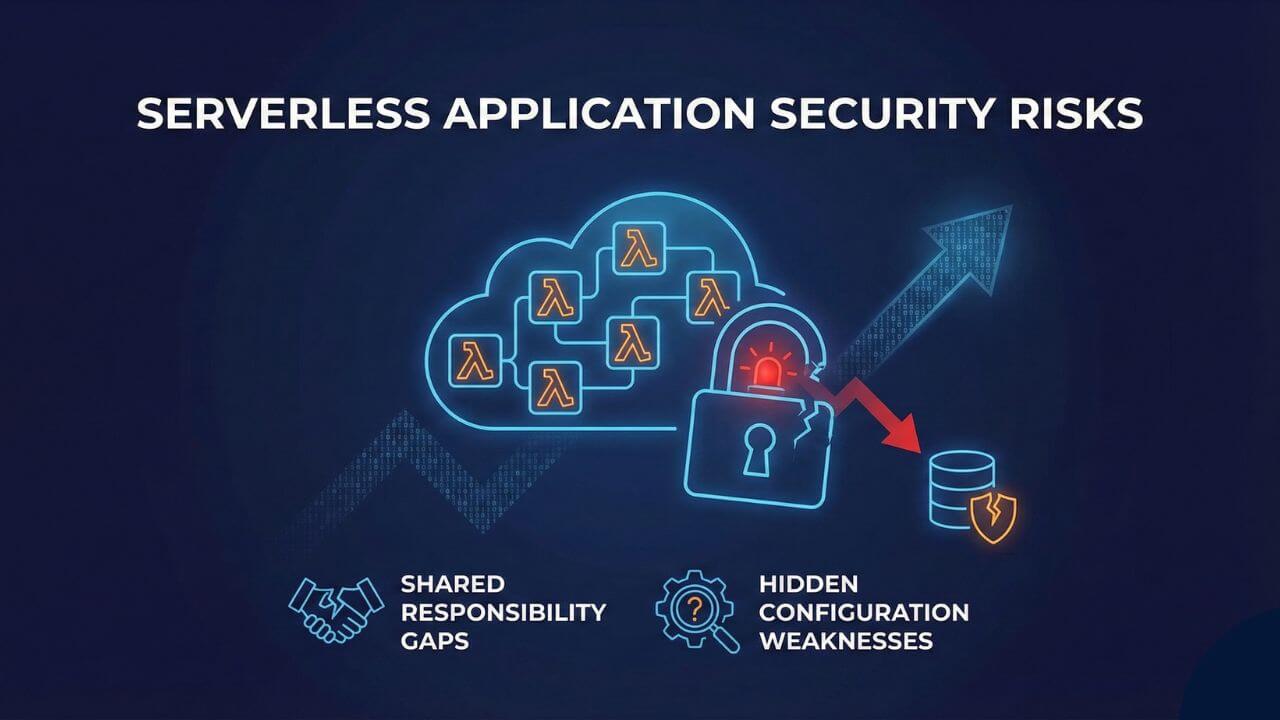
Serverless technology has become a dependable choice for companies looking to move faster without carrying the weight of infrastructure. AWS Lambda, API Gateway, S3, DynamoDB, and other managed services make it possible to build flexible systems with less operational overhead. The shift is appealing, but there is a tradeoff many teams overlook: serverless application security does not come built in. When the architecture becomes distributed, event-driven, and highly automated, small gaps can turn into real threats. Understanding how these systems behave is the first step toward keeping your business protected.

Table of Content
The Responsibility Shift That Often Catches Teams Off Guard
When companies move to serverless, the assumption is that AWS handles most of the security. That is partly true, but only at the infrastructure level. AWS protects the hardware, runtimes, and underlying systems. Everything else: permissions, event triggers, data paths, secrets, storage configurations, and application logic remains the responsibility of your team.
This is where many businesses get blindsided. A poorly configured trigger, an open S3 bucket, or an overly broad IAM role can give attackers more reach than they should ever have. Since serverless workloads rely on small, interconnected functions instead of single monolithic applications, an attacker only needs to compromise one piece to start moving deeper into your environment.
The distributed nature of serverless may look simple from a development standpoint, but it expands the number of paths a threat actor can take if the environment is not secured properly.
Why Weak Serverless Application Security Puts Your Data at Risk
Serverless functions may handle more sensitive information than developers realize financial data, authentication tokens, personal information, internal logs, or billing records. When serverless environments are misconfigured, attackers often go after the areas that receive less attention, such as event triggers or poorly protected storage.
A single unsecured event can expose confidential information. For example, an API path that accepts unvalidated input may allow injection attempts. An S3 bucket with permissive public access could expose private files. A Lambda function with broad permissions might grant unintended access to multiple AWS resources.
Because serverless architectures scale automatically, a breach can spread rapidly. Attackers don’t need powerful servers to exploit weaknesses. They only need to trigger a function repeatedly, leverage automation, and let the system harm itself.
Weak serverless application security doesn’t just create openings. It creates openings that expand themselves.
Hidden Weak Points That Make Serverless Attacks More Serious
Most serverless issues start with simple misconfigurations:
- A function with more access than necessary
• A trigger exposed to the public internet
• Outdated third-party libraries
• Environment variables containing plaintext secrets
• Overlooked test functions left running in production
What makes these weaknesses dangerous is the ease with which they can be chained together. Serverless functions often interact with numerous services across an account. If a function with broad IAM access is compromised, an attacker can use that position to read private databases, publish unauthorized messages, or extract sensitive files.
Serverless isn’t inherently riskier than traditional applications, but its modular nature means mistakes are easier to miss and harder to trace. When something goes wrong, it often happens fast.
How Weak IAM Practices Threaten Serverless Application Security
Access control is one of the most overlooked aspects of serverless design. Developers sometimes attach broad IAM roles to functions just to get things working. Over time, these roles remain unchanged and become part of production.
This creates ideal conditions for an attacker. If they compromise one function, they inherit all of its permissions. In environments where roles are shared, an attacker can escalate privileges quickly.
A safer approach requires:
- A unique IAM role for each function
• Restrictive, purpose-built permissions
• No wildcard actions unless absolutely necessary
• Resource-specific restrictions wherever possible
Strong IAM practices directly strengthen serverless application security. When permissions are tight, even a compromised function has little room to cause harm.
Why Poor Secrets Management Leads to Serious Exposure
Serverless systems rely on numerous external services databases, third-party APIs, payment gateways, authentication providers. Every one of these connections requires credentials. When secrets end up in the wrong place, the risk is immediate and severe.
Common mistakes include storing secrets:
- Inside environment variables
• In plain text within code
• In public Git repositories
• Inside logs
• In outdated or unused configuration files
Once exposed, attackers can move directly into critical systems.
Secure handling of credentials requires:
- AWS Secrets Manager or Parameter Store
• Encryption through AWS KMS
• Strict access controls
• Regular rotation
• Eliminating hard-coded secrets completely
Serverless environments often scale automatically, so a leaked key can multiply the impact across thousands of function executions.
How Weak Input Validation Turns Simple Events Into Attack Vectors
Serverless functions are activated by events, and events come from many places. Without strong validation, an attacker can craft malicious payloads that slip through unnoticed.
These issues show up in forms like:
- Injection attacks
• Malformed JSON payloads
• Oversized inputs meant to cause resource strain
• Unexpected data types or structures
• Spoofed event sources
Input validation is not optional. It’s essential. Validating schemas, filtering event sources, and sanitizing anything that interacts with databases or external services helps keep attacks contained. Serverless makes it easy to create complex pipelines, but without validation, those pipelines are easier to exploit.
When Visibility Breaks Down: Why Monitoring Matters for Serverless Application Security
Visibility is harder to maintain in serverless environments because functions run behind the scenes. There is no single application server to monitor, and traditional logging patterns don’t always apply.
Without strong monitoring, teams miss important signals:
- Sudden spikes in invocations
• Repeated authorization failures
• Function timeouts
• Suspicious API calls
• Abnormal data access patterns
Tools like CloudWatch, CloudTrail, and X-Ray help track how functions behave and how data moves across services. Effective monitoring also supports faster incident response, reduces the impact of breaches, and helps teams locate configuration mistakes before they become real problems.
A lack of visibility is one of the easiest ways for weak serverless application security to turn into a major business issue.
The Business Impact When Serverless Security Fails
The consequences of a serverless breach are rarely small. Depending on the data involved, a security incident can lead to:
- Exposure of sensitive customer information
• Compliance failures
• Regulatory penalties
• Operational downtime
• Service disruption
• Lost trust
• Damaged reputation
• Increased long-term security costs
Because serverless systems scale automatically, an attack can grow exponentially before anyone notices. A misconfigured trigger can be invoked thousands of times per minute, increasing the cost and the damage quickly.
Businesses often adopt serverless to save time and money. But without proper safeguards, the same system can create costs far higher than the infrastructure it replaced.
Practical Ways to Strengthen Weak Serverless Defenses
Improving security doesn’t require a massive overhaul. It requires consistent attention to foundational practices:
- Create narrow, purpose-built IAM roles
• Store all secrets in secure AWS services
• Validate and sanitize all inputs
• Disable unused triggers
• Use private networking where appropriate
• Keep functions and dependencies updated
• Remove unused layers and libraries
• Monitor logs and metrics continuously
• Integrate security checks into your CI/CD pipeline
These habits make serverless more reliable and dramatically reduce the risk of unexpected exposure.
Building Serverless Security Into Your Long-Term Strategy
Strong security isn’t a one-time task. Serverless systems evolve, and so do their risks. Teams need to audit permissions regularly, review function behavior, update configurations, and treat serverless architecture as part of a living environment. A long-term approach ensures that protections stay relevant as the system grows.
When companies embrace serverless thoughtfully, they can move quickly without sacrificing safety. The key is to understand where responsibility shifts and to treat serverless application security as a central part of the development process, not something to revisit only after an incident.
Want to Stay Ahead of Attackers? Read These Next:
- DevSecOps Best Practices: Integrating Security Early in Your CI/CD Pipeline
- 5 Cloud Misconfigurations That Lead to Data Breaches
- How Can Ethical Hacking Training Elevate Your Internal Cybersecurity?
- Top 5 Fileless Remote Access Trojans in 2025
- Top 5 IoT Remote Access Trojans Crippling Devices in 2025
- Top 5 Web-Based Remote Access Trojans That Are Dominating 2025
Why Businesses Trust SecureMyOrg for Comprehensive Network Security
At SecureMyOrg, we uncover and fix all possible security vulnerabilities of mobile and web, while providing solutions to mitigate risks. We are trusted by renowned companies like Yahoo, Gojek and Rippling, and with 100% client satisfaction, you’re in safe hands!







Some of the things people reach out to us for –
- Building their cybersecurity program from scratch – setting up cloud security using cost-effective tools, SIEM for alert monitoring, building policies for the company
- Vulnerability Assessment and Penetration Testing ( VAPT ) – We have certified professionals, with certifications like OSCP, CREST – CPSA & CRT, CKA and CKS
- DevSecOps consulting
- Red Teaming activity
- Regular security audits, before product release
- Full time security engineers.
Our Cybersecurity Services
Check Out New Updates

Top Cybersecurity Threats Facing Businesses In 2026

Top 5 Security Weaknesses Cloud-Native Apps Commonly Ignore
Why Weak Serverless Application Security Puts Your Business at Risk
What Is Penetration Testing as a Service?
How To Inspect Encrypted Traffic Without Breaking Privacy